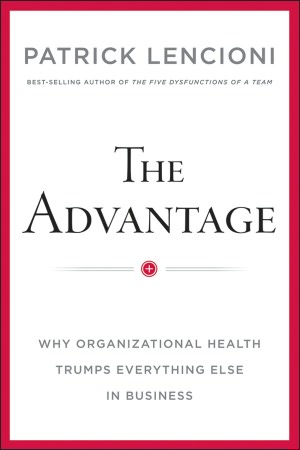
 Patrick Lencioni believes that the single greatest advantage any company can achieve is organizational health. Unfortunately, most leaders tend to ignore health and focus on growth. In order for growth to occur, health must be present. For example, the human body has nine different systems (skeletal, nervous, muscular, etc.). Health is dependent upon the proper functioning of those systems. Parents do not demand the physical growth of their child; Instead, they focus on his or her health. If all nine systems are working together properly, there is health, and consequently growth.
In his book, The Advantage: Why Organizational Health Trumps Everything Else in Business, Lencioni says an organization is healthy when it has integrity-not in the ethical or moral sense, but when it is whole, consistent and complete. It is healthy when all its systems (management, operations, strategy, culture, etc) are working together and make sense. Watkins (The First 90 Days, 2003) identifies this priority as achieving organizational alignment. Bossidy and Charan (Execution, 2002) have discovered that for organizations to execute effectively, they must have three core processes functioning healthily together: people, strategy and operations. Lencioni has brilliant yet simple insights. The remaining part of his book answers the question,
“What does an organization have to do to become healthy?”
Four Disciplines of Organizational Health Creating a healthy organization is a rigorous and disciplined endeavor. Lencioni has created a simple and clear model of four disciplines:

The first discipline is to build a cohesive leadership team. He defines a leadership team as, “a small group of people who are collectively responsible for achieving a common objective for their organization. Five behaviors are needed for building a cohesive leadership team:
- building trust
- mastering conflict
- achieving commitment
- embracing accountability
- focusing on results
Creating clarity is the second discipline of healthy organizations. Clarity is achieved when the leadership team is aligned and committed to the same answers to six simple questions:
- Why do we exist?
- How do we behave?
- What do we do?
- How will we succeed?
- What is most important right now?
- Who must do what?
The third discipline for creating organizational health is to over-communicate clarity. Once the leadership team has built behavioral cohesion and created clarity around answers to those six questions, it must then clearly, repeatedly and enthusiastically communicate those answers to the rest of the organization.
The fourth discipline for healthy organizations is to reinforce clarity through a few non-bureaucratic systems in every structure and process, including recruiting and hiring, interviewing, orientation, performance management, recognition and firing.
These four disciplines are simple principles, but initially require between one and six months to implement and gain momentum depending on the time and energy the leader allocates to the effort. It will be an effort that you won’t regret. The impact of organizational health reaches far beyond the company and into homes, lives and marriages. Lencioni concludes, “It sends people to work in the morning with clarity, hope and anticipation and brings them home at night with a greater sense of accomplishment, contribution and self-esteem.” It is hard to measure the ripple effect of this kind of impact in a leader’s life and organization.
What do you think? Which of the four disciplines would be most helpful to you right now? Comment on anything you would add.
[For more information and resources, go to http://www.tablegroup.com/
Comprehensive checklist for organizational health: http://www.tablegroup.com/advantagemodel/org-health/?tab=list
 Steve Morgan
 stevermorgan.com
Hello matte nice blog