Let’s face it. Growth is hard. At times, it can be downright painful – especially when the Professor Life shows up, replete with his curriculum of trials and hard circumstances. “Hey, I never signed up for that course with that professor!” you complain – until you embrace the suck, and if you have been intentional and reflective, find at the end, you learned some pretty cool stuff. Not happy HOW you learned it, but glad you did.
There are a myriad of ways to learn and grow.
Recently, my wife and I got to lead a Zoom session on “Steward Your Personal Growth” for new staff and interns in our organization. Before COVID, we had the privilege to teach all over the globe. We taught groups in mountains of Central Asia, in bustling cities of East Asia, in retreat centers outside Kenya, Chad and Nigeria and offices in Zimbabwe, in hotel settings in Europe and Latin America. We even taught in slippers – yes, you read that right – pink and blue slippers in South Korea (see picture below for proof). However, we had never taught this session remotely on Zoom.
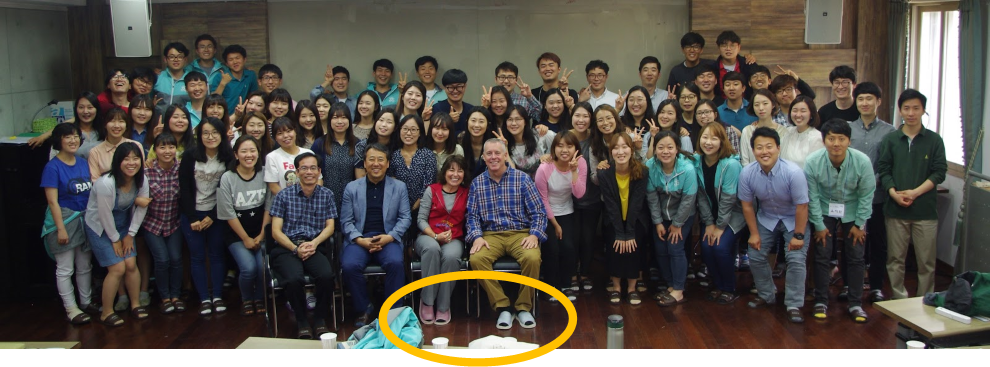
So, back to the classroom for us!
We spent several sessions learning from TED speaker, Chad Littlefield. He is big on creating connection before content and designing for contribution, not consumption. Check out some of his short videos: Do’s and Don’ts of Virtual Meetings, How to Make Virtual Meetings Fun, How to Make Online Meetings More Engaging, How to Run a Successful Virtual Meeting. [Added bonus – when you have limited time: Watch YouTube videos faster, by clicking on the gear wheel at the bottom of video controls, look for playback speed, then choose 1.5X or faster than normal speed] – You’re welcome 🙂
“Teach once, learn twice.” ~ Chinese proverb
The point is when we share, we learn double. That was true when we taught these helpful growth hacks with the group of new staff and interns.
- Stay humble – Bobby Clinton said the ability to learn is “the all-purpose tool, the Swiss Army knife, that leaders need to carry at all times.” If you think you know it all, there is nothing else to learn. Life long learning and growth begins with humility.
- Be curious – John Maxwell in “A Winners Daily Mindset” podcast encourages us to be curious and intentional to look for potential learning times with the people we meet.
- Understand – What works for you? How do you learn best – visual, auditory, read/write, kinesthetic? Take the simple VARK Questionnaire online if you are not sure. Are you a verbal or internal processor? How about the people you are leading or teaching?
- Identify – What gets in the way? What are your obstacles to growth? Ask someone to help you. Community often provides needed structure and accountability to stimulate growth.
- Invite Feedback – Ken Blanchard says “feedback is the breakfast of champions“. Feedback prepares us for better performance, and helps us grow, learn and develop. Want to become a feedback guru? Get your free copy of 30 Days of Feedback. Get feedback in advance using Marshall Goldsmith’s FeedForward method. Another way is to get feedback from others around you is to do a 360-degree review. Assessments or inventories are another form of feedback. (Think Myers-Briggs or Free Personality Test, StrengthsFinder, Birkman, Working Genius, DISC, EQi, Free 5 Voices Assessment, etc.) What assessments have you found helpful for your growth?
- The Development Cycle – One process that expresses our organizational commitment to helping people grow is the Development Cycle. This is a simple process of at least three conversations each year between a team leader, or supervisor and a team member. The tool we use is the Position Focus that includes Critical Mission Objectives (CMOs), a Professional Development Plan (PDP), and a Key Developmental Assignment (KDA) or stretch assignment. This provides direction and feedback on a persons’ contribution in a relationally rich, feedback environment.
So, you see, there really are a myriad of options to help you grow besides waiting for Professor Life to knock at your door and kick you around more this year. Why not take a more proactive and intentional route to develop your learning and growth plan this year?
After all, it is YOUR life.
Hey, what did I miss here? What helps you grow and learn?
 Steve Morgan
 stevermorgan.com
Outstanding insights. I love the thought of being curious–we don’t often think in terms of needing to think outside the box like that. To be intentional with others to really seek to learn is a challenge for all of us who think we know better. And how significant is feedback? To receive from others honestly what and how we can learn is so significant. Awesome post, my friend.
Thanks for engaging, my friend. I am trying to be more intentional to think about who I am meeting during the day and what questions I can ask them to learn from them. How do you practice curiosity?
I ask a lot of “Where did that thought or opinion or answer come from?” I’m finding, especially with the stories we tell of ourselves, that asking beyond the surface question usually opens up a whole new panorama. Plus I’m just super nosey.
That question can open up a whole new level of conversation. Super nosey? I would say, Super curious. I bet people can sense that you really care.
Lots of great resources here! Nice job summarizing our learning as we prepared to facilitate for others. It really is a full circle, isn’t it?!
Yes, Terry. Fun to do together. Thanks for your blog that includes some of the resources and your work on creating other resources also.