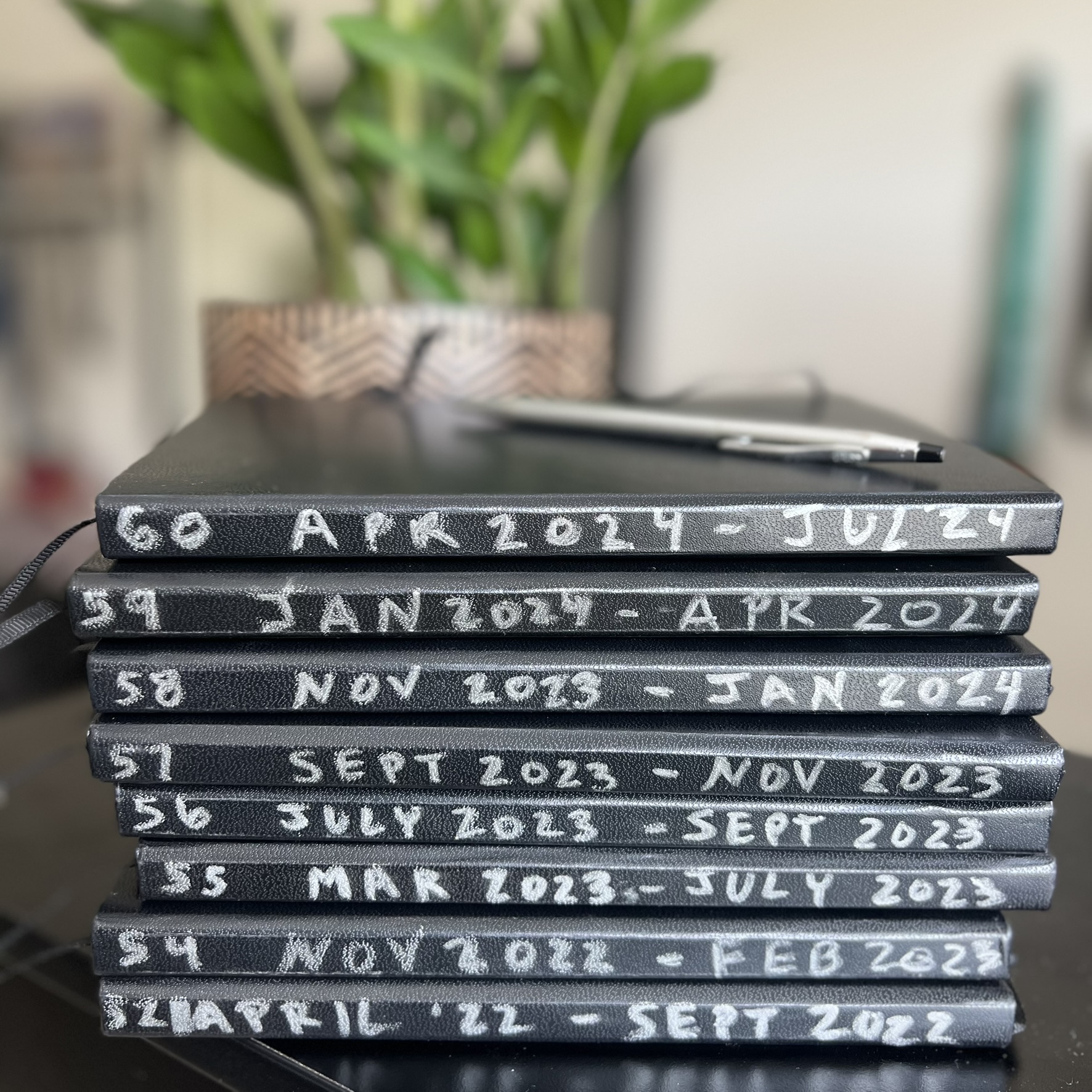
I filled my 60th journal today. That represents 44 years of capturing thoughts, feelings, ideas, notes, events, development, and growth possibilities. This seemed like a perfect time to reflect on several benefits of journaling I have experienced over the years, backed by research.
1. Leadership Development: Harvard Business Review (HBR) emphasizes that journaling is a powerful tool for leadership development. It allows leaders to reflect on their experiences, decisions, and interactions, leading to greater self-awareness and improved leadership skills. (Source: “Want to Be an Outstanding Leader? Keep a Journal.” by Nancy J. Adler (2016))
2. Enhanced Productivity: According to HBR, journaling can significantly boost productivity. It helps in organizing thoughts, prioritizing tasks, and reflecting on accomplishments and areas for improvement. (Source: “The More Senior Your Job Title, the More You Need to Keep a Journal” by Dan Ciampa (2017))
3. Stress Reduction and Emotional Regulation: Journaling can significantly reduce stress by providing an outlet for expressing and processing emotions. (Source: Smyth, J. M., et al. (2018). Journal of Experimental Psychology: General, 147(1), 139-146.) Regular journaling helps in better understanding and managing emotions. (Source: Gortner, E. M., et al. (2006). Behaviour Research and Therapy, 44(9), 1259-1272. )
4. Habit Formation: The act of regular journaling itself can improve discipline and help form other positive habits. (Source: Clear, J. (2018). Atomic Habits: An Easy & Proven Way to Build Good Habits & Break Bad Ones.)
5. Creativity Boost: Journaling can enhance creative thinking and expression. (Source: Kaufman, S. B., & Gregoire, C. (2015). Wired to Create: Unraveling the Mysteries of the Creative Mind.) HBR suggests that journaling can foster creativity and innovation by providing a space for free-flowing ideas and unconventional thinking.
6. Learning from Experience: HBR emphasizes journaling as a way to extract maximum learning from daily experiences. This practice can accelerate professional growth and development.
7. Enhanced Problem-Solving Skills: Journaling can lead to better problem-solving abilities by allowing for reflection and analysis. (Source: Pennebaker, J. W., & Beall, S. K. (1986). Journal of Abnormal Psychology, 95(3), 274-281.) Articles in HBR suggest that journaling can enhance problem-solving skills by allowing individuals to explore different perspectives and solutions without immediate judgment.
8. Better Sleep: Journaling before bed can help clear the mind and improve sleep quality. (Source: Scullin, M. K., et al. (2018). Journal of Experimental Psychology: General, 147(1), 139-146.)
Recommended Practices: In light of all these personal and research-backed benefits of journaling, here are my top practical tips for effective journaling.
a. Set aside a dedicated time for journaling. Choose a regular time that works for you.
b. Some people like to use journaling prompts. I have used prompts occasionally. More recently, I began with a health summary from my Garmin watch and morning exercise. I fill in other thoughts later in the day. Try both methods. There is no right or wrong way. Find what works for you.
c. Focus on both success and challenges. Ask yourself what has gone well, what is not going well, and what you are learning.
d. Review entries periodically to identify patterns and insights. I leave two or three pages in the beginning to create an index of topics, like a table of contents, for easier review and retrieval.
e. Enjoy the process, and don’t worry if you miss a day. Give yourself grace.
What benefits most resonate with you? What benefits have you experienced from journaling?
Other posts you may like:
 Steve Morgan
 stevermorgan.com
Brilliantly said, Steverino! I’ve been journaling since 1979–SO long ago. I did it to help me focus on time with the Lord and allow Him to speak into my life. I do it early in the morning–it’s my favorite time, when the house is quiet, and life is fresh. Really great reasons to journal–one of the best is it allows me to think outside my own box and consider choices I’d made in the previous day. Great blog, my friend.
Thanks for reading, Dayle. 1979 was when I came to know the Lord and began journaling. I was in Green Bay. You and John might have been in WI at the same time. I usually journal before I start work and again at the end of the day. I love the way you use journaling to reflect on the previous day. Keep journaling.